
Understanding Cabinet Box Construction: What's Inside the Cabinet Matters as Much as What's Outside
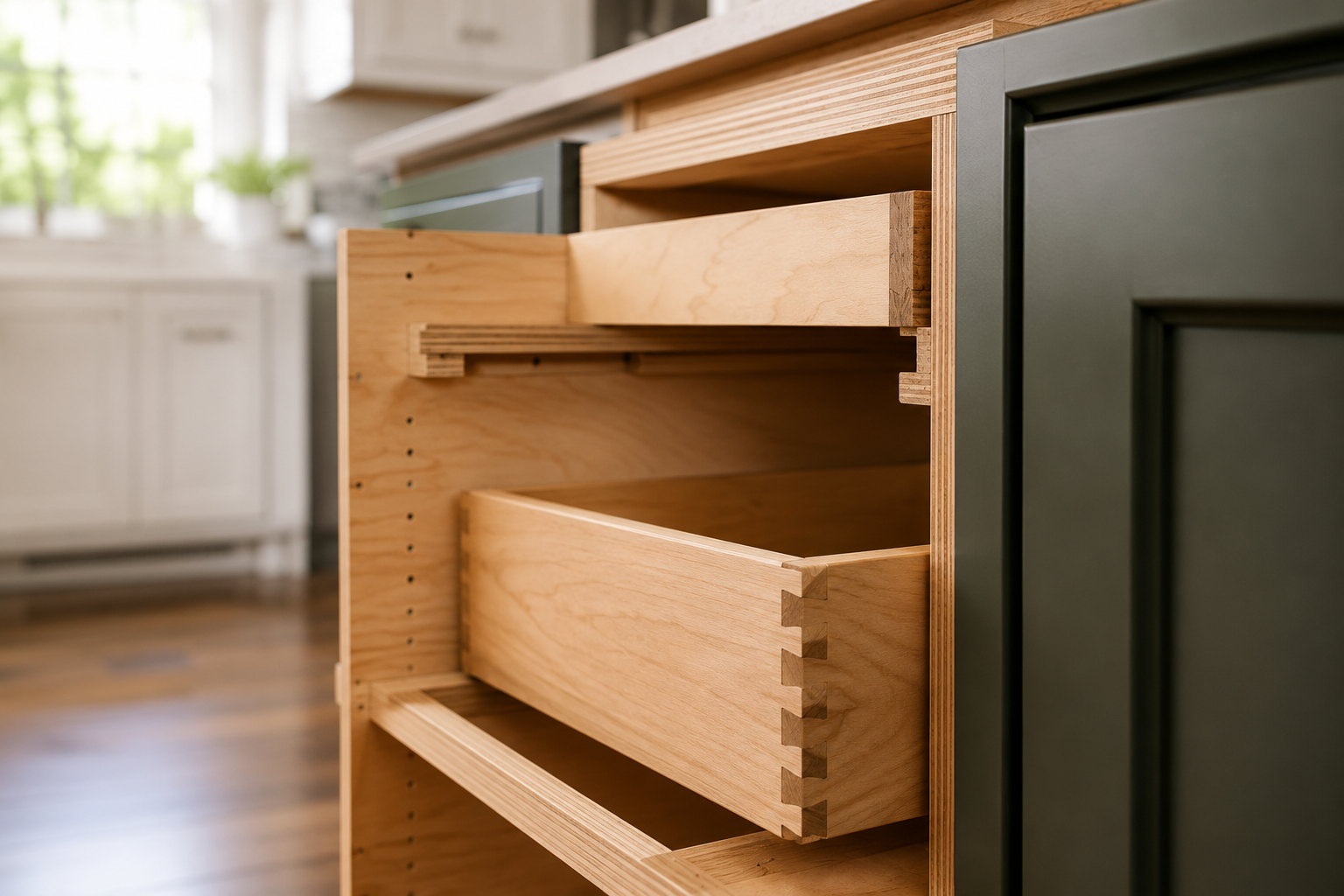
The conversation around custom cabinetry almost always begins with what is visible: door styles, finish colors, hardware selections, and countertop materials. These are the elements that photograph well and drive early design excitement, which makes them natural starting points. But the component that determines how a cabinet performs over the next twenty or thirty years is not the door front or the finish. It is the box behind it, and understanding what goes into a well-built cabinet box is one of the most valuable things a homeowner can know before making a significant cabinetry investment.
Cabinet boxes are constructed from one of three primary sheet goods: plywood, medium-density fiberboard, or particleboard. Each material has a different structural profile, weight, moisture resistance, and cost, and the choice between them has real consequences for long-term performance. Plywood, built from cross-laminated wood veneers, is the strongest and most moisture-resistant of the three, holding screws and fasteners reliably even after years of use and resisting the swelling and delamination that moisture exposure causes in lower-grade materials. It is the preferred material for quality custom cabinetry for these reasons, even though it commands a higher material cost.
Medium-density fiberboard offers a smooth, consistent surface that machines and paints exceptionally well, making it a reasonable choice for specific applications like door fronts and decorative panels where its paint-ready surface is an advantage. As a cabinet box material, however, MDF is significantly heavier than plywood, less resistant to moisture at edges and cut surfaces, and holds fasteners less reliably over time, particularly in high-use areas where hinges and drawer slides are subjected to repeated stress. It is a material with legitimate uses in cabinetry, but box construction is not where it performs best.
Particleboard sits at the lower end of the material spectrum, used predominantly in production cabinetry where cost reduction is the primary driver. It is the heaviest of the three options, the least moisture-resistant, and the most prone to failure at fastener locations over time. Particleboard cabinet boxes can perform adequately in low-humidity environments with careful use, but they are fundamentally less durable than plywood construction and represent a meaningful compromise in the long-term performance of a cabinetry system, regardless of how attractive the exterior finish appears at the time of installation.
Face frame versus frameless construction represents a second significant dimension of cabinet box design that affects both aesthetics and interior accessibility. Face frame cabinetry attaches a solid wood frame to the front of the cabinet box, covering the raw edges of the box material and providing a traditional, furniture-like appearance at the cabinet opening. Frameless cabinetry, sometimes called European-style construction, eliminates this frame entirely, allowing doors and drawers to cover the full face of the box and providing slightly more interior access width for the same exterior cabinet dimension.
Joinery method within the box itself, how the sides, top, bottom, and back panels are connected to each other, is the final layer of construction quality that separates a durable cabinet from one likely to loosen and rack over time. Dado joints, where panels are recessed into a channel cut into the adjoining panel, create a mechanical connection that resists racking forces far better than butt joints held together with staples or fasteners alone. A back panel dadoed into the sides rather than simply stapled or nailed to the back edge of the box adds significant rigidity to the entire assembly, keeping the cabinet square and stable under the weight of daily use.
At Trailblazer Woodworks, cabinet box construction begins with plywood and joinery methods chosen for long-term structural performance rather than short-term cost reduction, because the box is the foundation everything else depends on. A beautifully finished door on a poorly constructed box is a short-term result, and custom cabinetry should be built to perform and look exceptional for decades, not just on installation day.
