
The Details Behind a Truly Custom Drawer: Construction, Hardware, and Fit
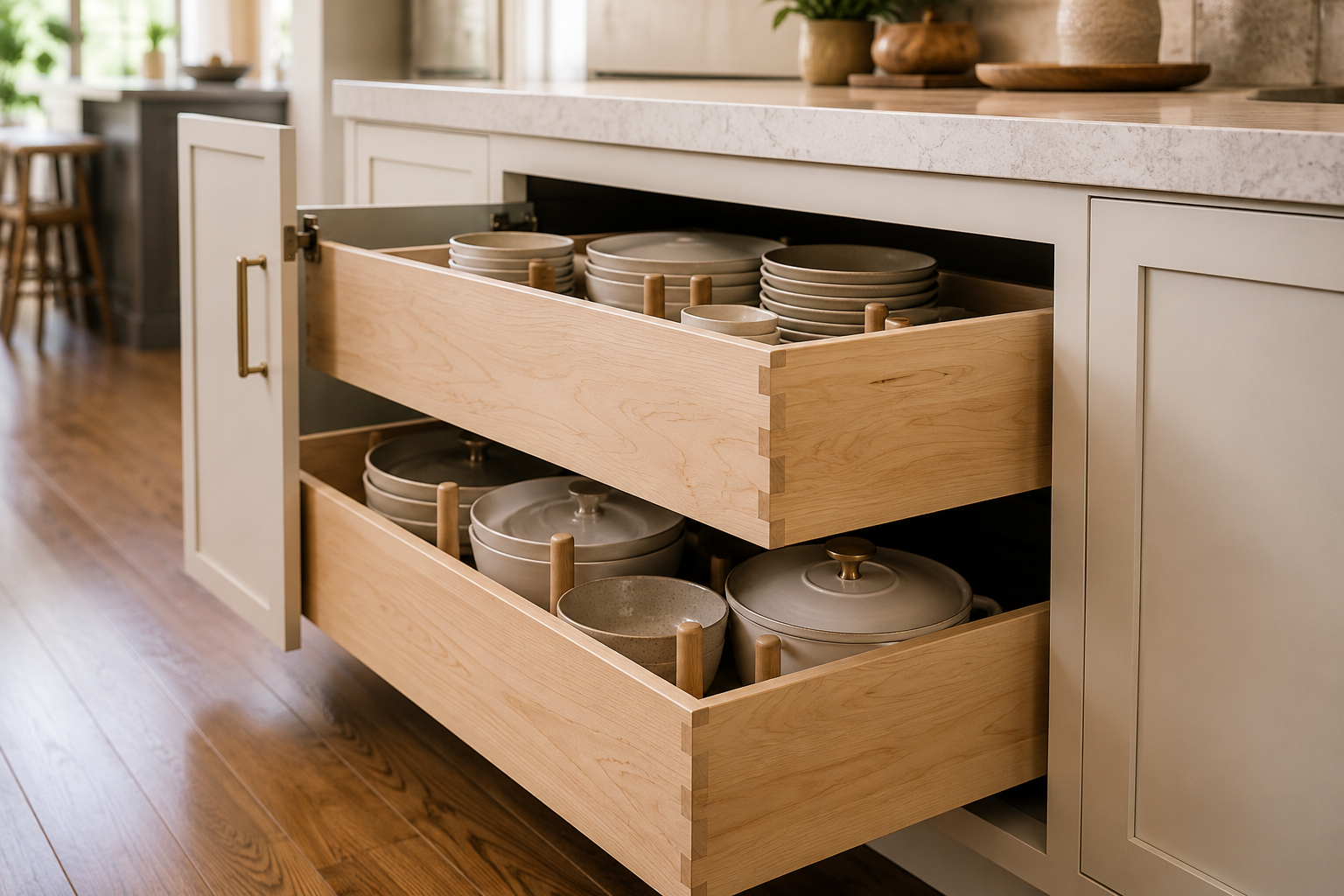
Drawers are among the most frequently used components in any cabinetry system, opened and closed dozens of times a day across the lifetime of a kitchen or bathroom. Yet they are also among the most overlooked in terms of construction quality, with many homeowners focused on door styles and finishes while assuming all drawer boxes are roughly equivalent beneath the surface. The reality is that drawer construction varies significantly across cabinetry tiers, and those differences show up clearly in how a drawer feels to use, how long it performs reliably, and how well it holds up under the weight and frequency of daily use.
Drawer box material is the starting point for understanding construction quality. Lower-tier cabinetry commonly uses stapled together particleboard or MDF drawer boxes that are inexpensive to produce but susceptible to moisture damage and structural failure over time, particularly at the joints where the sides meet the front and back panels. Solid wood or Baltic birch plywood drawer boxes represent a meaningful step up in durability and moisture resistance, holding their shape and structural integrity significantly longer under real-world use conditions.
Joinery method separates entry-level drawer construction from genuinely custom work more clearly than almost any other detail. A dovetail joint, where interlocking angled fingers of wood are cut and fitted together at the drawer corners, creates a mechanical connection that becomes stronger under tension rather than weaker, which is precisely the kind of stress a drawer joint experiences every time the drawer is pulled open under load. Compared to stapled or doweled joints, a properly cut dovetail is both a functional and aesthetic statement about the level of craftsmanship behind the cabinet.
Drawer slide selection has an enormous impact on the daily experience of using a cabinet, yet it is an area where cabinetry specifications frequently cut corners in ways that are not immediately visible during a showroom visit. Undermount slides, which attach beneath the drawer box and remain completely hidden when the drawer is open, offer the cleanest visual result and typically the smoothest, most controlled motion. Side-mount slides are more common in budget cabinetry and perfectly functional when specified at a quality tier, but they are visible along the interior sides of the cabinet opening in a way that undermount systems are not.
Weight capacity is a practical specification that deserves more attention than it receives in drawer planning conversations. A drawer designated for pots and pans, cast iron cookware, or heavy kitchen equipment needs slides rated for significantly more weight than one holding utensils or spices. Specifying the right slide capacity for each drawer's intended use prevents premature wear and ensures the drawer continues to operate smoothly under the actual loads it will carry rather than failing early because it was under-specified from the start.
Interior organization within the drawer box is the final layer of customization that transforms a well-built drawer into a genuinely useful one. Peg systems for dishware, knife blocks integrated into drawer interiors, felt-lined sections for flatware or jewelry, and custom divider configurations designed around specific items all turn raw storage volume into organized, purposeful space. These details require planning around how each drawer will actually be used before fabrication begins, which is a conversation that custom cabinetry makes possible in a way that stock options simply do not.
At Trailblazer Woodworks, every drawer is built and specified as a complete system, from the material and joinery of the box itself to the slide mechanism and interior organization that determines how it functions in daily use. A drawer that opens smoothly, holds its contents securely, and continues performing reliably years after installation is not a minor detail but a fundamental measure of what custom cabinetry is meant to deliver.
